
By Mind Sense Academy
At Mind Sense Academy, we train athletes to master their inner world just as deeply as they train their physical game. One of the most valuable tools we use inside our Breathworks Program is HRV—Heart Rate Variability.
It’s one of the simplest numbers an athlete can track, yet it reveals more about performance, resilience, and stress than most people realize.
What Exactly Is HRV?
HRV measures the tiny changes in time between each heartbeat. Instead of your heart beating in a perfectly steady rhythm, the spacing actually shifts from moment to moment. Those shifts are controlled by your autonomic nervous system—the system responsible for stress, recovery, calm, and readiness.

- Higher HRV → your body is adaptable, resilient, and recovering.
- Lower HRV → your system is stressed, tired, or overloaded.
To us, HRV is the athlete’s internal dashboard.
Why HRV Matters for the Athletes We Work With
1. It Shows Recovery You Can’t “Feel”
Athletes often say they feel fine even when their nervous system is overloaded. HRV gives us objective truth.
A high HRV tells us an athlete is ready for intensity. They are rested or are in recovery mode.
A low HRV tells us their system is still under stress. They need to recover and rest.
This helps us guide them toward smarter training—not harder training.
2. It Reflects Mental Strength, Not Just Physical
At Mind Sense Academy, we care deeply about the internal game. HRV gives us a direct look at an athlete’s mental and emotional load.
Higher HRV is linked with:
- Better focus
- Greater calm during pressure
- Faster emotional recovery after mistakes
- Stronger decision-making
It’s the kind of mental advantage that changes how an athlete competes.
3. It Helps Us Personalize Breath Training
Inside the Breathworks program, we use HRV as both a measure and a teaching tool.
When athletes breathe in certain rhythms, their HRV responds instantly.
The right breath pattern can raise HRV in minutes—showing athletes real-time proof that they can regulate stress, energy, and focus anytime they choose.
This is where the science becomes self-mastery.
How We Measure HRV at Mind Sense Academy
We use two reliable tools depending on the training environment:
1. Fitness Tracker (whoop, oura ring, garmin, etc)
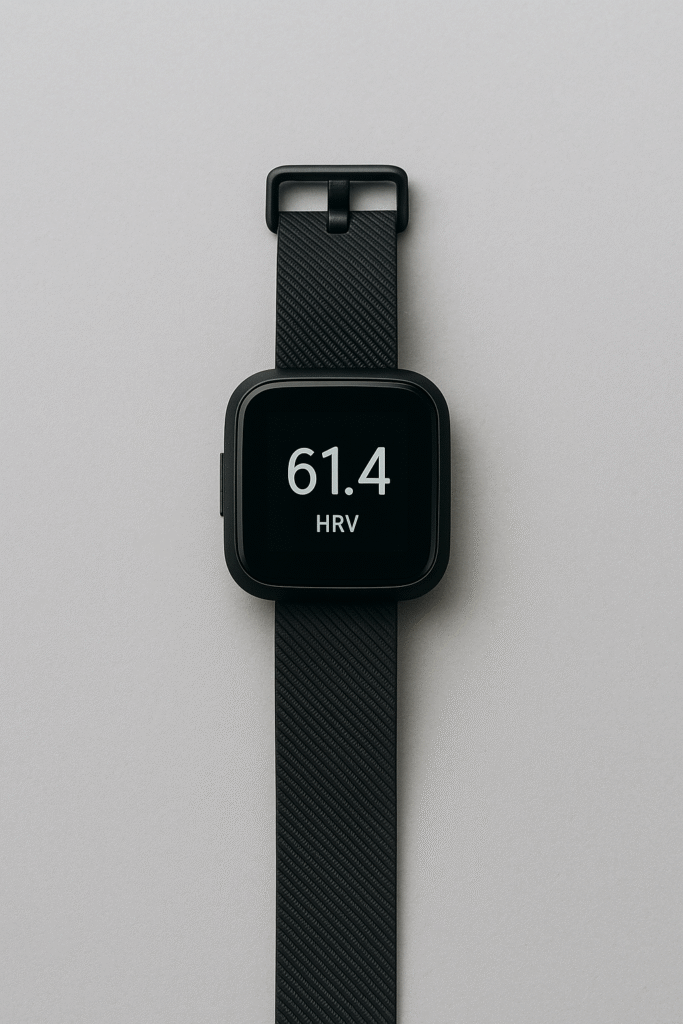
Great for daily recovery snapshots, WHOOP automatically records HRV during deep sleep. We use this to help athletes understand their baseline and track long-term trends. Most of these devises only track HRV while sleeping, not during performance.
2. High-Frequency Chest Strap
For performance sessions, we use a chest strap such as the Mind Sense Chest Strap to capture HRV in real time. This gives us precise data during:
- Breath training
- Cooldowns
- Post-game assessments
- Mental resilience drills
It’s one of the most accurate ways to see how the nervous system is functioning in the moment.

Our Recent Study With 12–15 Year-Old Soccer Players
To understand how young athletes respond to competitive stress, we recently tested a group of boys (ages 12–15) immediately after active practice.
Average HRV after activity: 61.4
Here’s what that number tells us:
- Their nervous systems were still in a sympathetic (fight-or-flight) state.
- Their recovery mechanisms had not fully activated.
- Many players appeared calm on the outside but were still carrying internal stress.
- The cooldown period alone wasn’t enough to rebalance the system.
This is exactly why tools like Breathworks matter: athletes need guidance on how to shift their nervous systems on purpose, not just wait for recovery to eventually kick in.
What This Means for Parents, Coaches & Athletes
HRV gives us a clearer, smarter way to train:
- We prevent overtraining.
- We identify hidden fatigue before it turns into injury.
- We teach athletes how to self-regulate under pressure.
- We build long-term resilience, not just short-term wins.
Inside Mind Sense Academy, HRV isn’t just a number—it’s a roadmap. Paired with our Breathworks curriculum, it becomes a tool athletes use to understand themselves deeply and perform with intention, clarity, and control.
When an athlete learns to control their breath…
they learn to control their mind.
When they control their mind…
they transform the way they compete.
And HRV gives us the proof.